
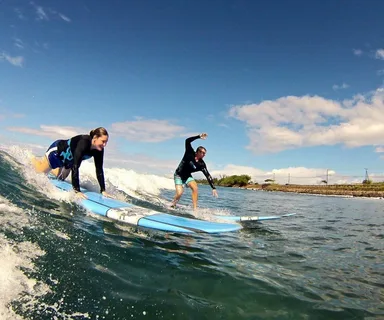
Surf Lesson for Beginners
Learning to surf can be an exciting experience, but getting started in the ocean can also feel challenging. Beginners often worry about balancing on the board, understanding waves, and knowing when to stand up. The right surf lesson for beginners can make these challenges easier by teaching essential skills in a safe, supportive, and enjoyable environment.
Surfing is more than standing on a board and riding a wave. It requires balance, coordination, patience, ocean awareness, and practice. For new surfers, learning these skills with proper guidance can help build confidence and reduce common beginner mistakes.
A well-planned surf lesson introduces students to the basics before they enter the water. It explains how to choose the right surfboard, understand ocean conditions, paddle correctly, and maintain a safe position in the waves. With clear instructions and hands-on practice, beginners can gradually become more comfortable in the ocean.
Whether someone is learning alone, planning a family activity, or looking for surf lessons for kids, professional instruction can make the experience more rewarding. Programs such as Local Boys Surf Adventure can also be considered by people exploring opportunities to learn and enjoy surfing.
Explains what beginners can expect from their first surf lesson, how lessons build confidence, and what skills help new surfers develop safely.
1. Understanding What Happens During a Surf Lesson for Beginners
A first surf lesson introduces students to surfing through simple instructions and practical exercises. Instead of expecting beginners to master everything immediately, instructors usually break the experience into smaller steps.
This approach makes learning easier and helps students understand what to do before attempting to catch a wave.
Learning the Basics Before Entering the Water
A beginner lesson often starts with an introduction to surfing equipment and basic ocean safety.
Students learn about:
- Different types of surfboards and their uses.
- How to carry and position a surfboard.
- Basic surfing terms and instructions.
- How waves form and move toward the shore.
- The importance of checking ocean conditions.
- Basic surf etiquette and awareness of other surfers.
Understanding these fundamentals helps beginners feel more prepared.
For example, a new surfer may not know why instructors recommend larger boards for learning. A wider, longer beginner board generally provides more stability and makes balancing easier than a smaller performance board.
Learning these details before entering the water can reduce confusion and make the first experience more enjoyable.
Practicing on Land First
Many beginner lessons include practice on the beach before students enter the ocean.
One important exercise is the pop-up. This is the movement used to transition from lying on the surfboard to standing on it.
Students practice placing their hands correctly, pushing their upper bodies upward, and bringing their feet underneath them in one controlled movement.
Practicing on land helps beginners understand the movement without worrying about waves or water conditions.
Once students become familiar with the basic technique, they can begin practicing in shallow water under appropriate supervision.
Setting Realistic Expectations
A first lesson is about learning, not achieving perfection.
Some beginners may stand on their boards quickly, while others need several attempts. Both experiences are normal.
The most valuable outcome is understanding the basic movements, becoming more comfortable in the water, and developing the confidence to continue practicing.
2. Choosing the Right Surfboard and Equipment
The right equipment can make a major difference in a beginner’s surfing experience. A suitable surfboard provides stability, while comfortable clothing and safety equipment allow students to focus on learning.
Why Beginners Need the Right Surfboard
Choosing a surfboard based on appearance or professional surfing trends can lead to unnecessary difficulties.
Experienced surfers often use smaller boards because they allow advanced maneuvers and greater control. However, these boards can be challenging for people who are still learning balance and basic positioning.
Beginner surfers generally benefit from:
- Longboards: Longer boards offer more surface area and stability.
- Soft-top surfboards: Soft surfaces can make beginner practice more comfortable.
- Wide boards: Additional width can help students maintain balance.
- Higher-volume boards: More volume generally provides better flotation.
The best board depends on the student’s height, weight, fitness level, experience, and local wave conditions.
An instructor can help select suitable equipment before the lesson begins.
Essential Surfing Equipment
Besides the surfboard, several other items can improve comfort and safety.
| Equipment | Purpose |
|---|---|
| Surfboard leash | Helps keep the board connected to the surfer |
| Rash guard | Helps protect the skin from irritation |
| Wetsuit | Provides warmth in cooler water |
| Sunscreen | Helps protect exposed skin from sun damage |
| Water-resistant footwear | May protect feet in suitable surf environments |
| Towel and drinking water | Support comfort after the lesson |
Not every student needs all these items. Equipment requirements depend on water temperature, beach conditions, and the lesson location.
Beginners should ask the instructor which items are provided and what they need to bring.
Comfort Makes Learning Easier
Uncomfortable equipment can distract students from learning.
A wetsuit that fits poorly, a board that feels too difficult to control, or a leash that is incorrectly attached can create unnecessary problems.
Proper equipment selection helps students focus on paddling, balancing, and understanding the waves.
3. Learning Ocean Safety and Wave Awareness
Ocean safety is one of the most important parts of any surf lesson for beginners. Surfing takes place in a changing natural environment, so students need to understand basic water conditions before attempting to ride waves.
Understanding Different Ocean Conditions
Not every beach offers the same surfing environment.
Wave size, currents, tides, wind, and underwater features can all affect surfing conditions.
Beginners should learn to recognize:
- Small waves: Often more suitable for basic practice, depending on the conditions.
- Strong currents: Can move swimmers and surfers away from their intended position.
- Rip currents: Narrow channels of water flowing away from shore.
- Shore breaks: Waves that break close to the beach and may create challenging conditions.
- Changing tides: Water levels that can affect wave behavior and beach access.
A beginner should never assume that small-looking waves are automatically safe.
An instructor should assess the conditions and choose an appropriate learning area.
Understanding Rip Currents
Rip currents are powerful channels of water that flow away from the shoreline.
They can create dangerous situations for people who do not know how to respond.
Beginners should understand these basic safety principles:
- Avoid entering the water when conditions appear dangerous.
- Follow local beach warnings and lifeguard instructions.
- Never surf alone.
- Stay within the instructor’s designated practice area.
- Learn how to recognize and respond to rip currents.
If caught in a rip current, a person should try to remain calm, float to conserve energy, signal for help, and swim parallel to the shore if able before returning toward the beach.
When in doubt, beginners should follow lifeguard guidance rather than attempting to handle dangerous conditions independently.
Learning Surf Etiquette
Surf etiquette helps prevent accidents and creates a respectful surfing environment.
Important beginner rules include:
- Avoid dropping in on another surfer’s wave.
- Give other surfers enough space.
- Do not paddle directly into someone’s path.
- Maintain control of the surfboard.
- Follow instructions from instructors and lifeguards.
- Understand the designated surfing and swimming areas.
Knowing these rules helps beginners become responsible members of the surfing community.
4. Building Confidence Through Simple Surfing Techniques
Confidence develops when beginners understand what they are doing and have enough time to practice.
A structured lesson focuses on basic techniques instead of introducing too many skills at once.
Learning the Correct Paddling Position
Paddling is one of the first physical skills a beginner needs to understand.
Students learn how to lie in the center of the surfboard while keeping their bodies balanced.
If they lie too far forward, the nose of the board may dip into the water. If they lie too far back, the board may become difficult to move efficiently.
The correct position allows the board to glide more smoothly.
Beginners should practice:
- Keeping their body centered.
- Looking forward instead of constantly looking down.
- Using controlled arm movements.
- Avoiding unnecessary movement.
- Maintaining a relaxed body position.
Good paddling technique helps students move toward suitable waves with better control.
Mastering the Pop-Up
The pop-up is one of the most recognizable surfing movements.
It allows surfers to move from a lying position to a standing position when catching a wave.
A beginner can break this movement into simple steps:
- Lie flat on the surfboard in the correct position.
- Place both hands near the chest.
- Push the upper body upward.
- Bring the feet underneath the body.
- Position the feet across the board.
- Bend the knees and maintain balance.
- Keep the eyes looking forward.
Beginners should avoid standing too upright because a lower, balanced position provides better control.
The movement may feel awkward at first. Repeated practice on land and in suitable water conditions can help improve coordination.
Finding Balance on the Board
Balance is essential for staying upright while riding a wave.
New surfers often make the mistake of looking down at their feet. This can affect body position and make it harder to maintain stability.
Instead, students should look in the direction they want to travel.
Keeping the knees slightly bent and the body relaxed can also improve balance.
The goal is not to remain completely stiff. Small adjustments help surfers respond to changes in the board’s movement.
5. Exploring Surf Lessons for Kids and Family Learning
Surfing can be an enjoyable outdoor activity for children when lessons are designed around their age, swimming ability, confidence, and physical development.
Surf lessons for kids should focus on safety, simple instructions, and positive experiences rather than pressure to perform.
Why Children Can Benefit From Surf Lessons
Surfing introduces children to an active outdoor environment while helping them develop useful physical and personal skills.
Depending on the child’s age and experience, lessons can support:
- Balance and coordination.
- Physical activity and movement.
- Confidence in suitable water environments.
- Listening and following instructions.
- Patience and persistence.
- Respect for nature and ocean safety.
Children may also enjoy learning alongside other students, making surfing a social experience.
However, every child learns differently. Some may feel excited about entering the water, while others may need more time to become comfortable.
What Makes a Good Kids’ Surf Lesson?
Children need an approach that matches their learning abilities.
A suitable lesson should include:
Age-appropriate instruction: Younger students benefit from short, clear explanations and demonstrations.
Suitable equipment: Smaller, stable boards can make basic practice easier.
Close supervision: Qualified instructors should provide appropriate supervision based on the children’s ages and conditions.
Positive encouragement: Children should receive support without being pressured to stand up or ride waves before they are ready.
Water safety education: Students should learn basic beach awareness and understand the importance of following instructions.
Parents should ask about instructor qualifications, supervision arrangements, student-to-instructor ratios, and minimum swimming requirements before booking.
Making Surfing a Family Activity
Surfing can also create opportunities for families to spend time outdoors together.
Parents and children can learn basic techniques, practice water safety, and celebrate small improvements.
A family lesson may also help children feel more comfortable because they can see adults learning alongside them.
The most important goal is creating a safe and enjoyable experience that encourages continued interest in the sport.
6. Knowing When to Move Beyond Beginner Surfing
After learning basic surfing techniques, some students may want to develop their skills further.
Moving beyond beginner lessons should happen gradually. Students need a strong foundation before attempting more difficult waves or advanced maneuvers.
Signs That a Student Is Ready for More Challenges
Progress depends on individual ability, not simply the number of lessons completed.
A student may be ready to explore the next level when they can:
- Paddle toward suitable waves with reasonable control.
- Understand basic surf etiquette.
- Position themselves correctly on the board.
- Perform a controlled pop-up.
- Maintain balance while riding small waves.
- Follow ocean safety instructions.
- Understand when conditions are unsuitable for surfing.
These skills provide a foundation for more challenging practice.
However, being able to stand on a board does not automatically mean someone is ready for bigger waves.
Ocean awareness and decision-making remain essential.
What to Expect From Advanced Surf Classes
Advanced surf classes are designed for surfers who already understand the fundamentals and want to improve their performance.
Depending on the program and student’s ability, advanced instruction may cover:
Wave selection: Learning to identify suitable waves based on their shape, direction, and breaking pattern.
Take-off positioning: Improving the timing and positioning needed to catch waves effectively.
Turning techniques: Developing control when changing direction on a wave.
Speed generation: Learning how body positioning and weight distribution influence movement.
Reading surf conditions: Understanding how changing tides, wind, and wave patterns affect surfing opportunities.
Advanced surf etiquette: Applying surfing rules in busier and more challenging environments.
Advanced instruction should still match the student’s experience and the conditions.
A surfer should never move into difficult waves simply to prove their ability.
Why Continued Coaching Matters
Surfing skills develop through consistent practice and useful feedback.
An instructor can identify mistakes that students may not notice themselves.
For example, a surfer might repeatedly lose balance because their feet are positioned too close together. Another may struggle to catch waves because they begin paddling too late.
Small adjustments can make a meaningful difference.
Continued coaching also helps surfers develop better judgment about when to enter the water and which waves are appropriate for their skill level.
7. Choosing the Right Surf School and Getting the Most From Each Lesson
The quality of instruction can influence how comfortable and confident beginners feel during their first surfing experience.
Choosing a suitable surf school requires more than comparing lesson prices. Students should consider safety standards, instructor experience, teaching methods, equipment, and the learning environment.
What to Look for in a Surf School
Before booking, beginners should consider the following factors:
Qualified instructors: Look for instructors with relevant surf coaching and water safety training.
Beginner-friendly lessons: The program should explain basic techniques clearly and provide time for practical exercises.
Safety procedures: The school should assess ocean conditions and explain emergency procedures.
Suitable equipment: Beginners should have access to boards appropriate for their body size and experience.
Small learning groups: Smaller groups may allow instructors to provide more individual feedback.
Clear communication: Students should understand lesson duration, equipment arrangements, meeting points, and any additional requirements before booking.
Reviews and recommendations can help, but they should not replace direct questions about safety and teaching practices.
Considering Local Boys Surf Adventure
People researching surfing experiences may come across Local Boys Surf Adventure when exploring possible learning opportunities.
Before choosing any surf program, beginners should check the services currently offered and confirm whether the program provides instruction appropriate for their experience level.
Useful questions include:
- Are beginner surfing lessons available?
- Are instructors trained in surf coaching and water safety?
- Is equipment included in the lesson?
- Are lessons available for children?
- What swimming ability is required?
- How are ocean conditions assessed before lessons?
- What happens if weather or surf conditions are unsuitable?
These questions help students make informed decisions without relying on assumptions about a program’s services.
Preparing for the First Surf Lesson
A little preparation can make the first experience more comfortable.
Beginners should:
- Get enough rest before the lesson.
- Eat a suitable meal beforehand.
- Drink enough water.
- Apply water-resistant sunscreen.
- Bring comfortable swimwear.
- Follow all instructor instructions.
- Arrive early enough to prepare.
- Inform the instructor about any concerns or limitations that may affect participation.
Students should also avoid comparing their progress with other people.
Some learners may stand up quickly, while others need more time to understand the movements. Both are normal parts of the learning process.
Making Progress Between Lessons
The learning process does not end when a lesson finishes.
Beginners can improve their understanding by reviewing the techniques they learned and practicing suitable movements on land.
For example, practicing the pop-up on a soft surface can help improve coordination and movement.
Students can also learn more about wave formation, surf etiquette, and ocean safety.
However, water practice should always take place under suitable conditions and with appropriate supervision.
Consistent practice, patience, and professional feedback can help turn a nervous beginner into a more confident surfer.
Frequently Asked Questions
1. How many lessons does a beginner need to learn surfing?
The number of lessons depends on the student’s fitness, balance, swimming ability, confidence, and the conditions available for practice. Some beginners may stand on a surfboard during their first lesson, while others need several sessions to become comfortable with paddling and the pop-up. Regular practice and professional feedback can help students develop their skills over time.
2. Is a surf lesson for beginners suitable for someone who cannot swim well?
Surfing lessons require appropriate water confidence and swimming ability. People who cannot swim well should not assume that a beginner surf lesson is suitable for them. They should discuss their ability with the surf school before booking. Students should also follow any minimum swimming requirements and never enter the ocean without appropriate supervision.
3. What is the best age for children to start surfing?
There is no single ideal age for every child. Readiness depends on swimming ability, physical development, comfort in the water, attention span, and the surf school’s age requirements. Parents should choose age-appropriate surf lessons for kids with suitable equipment, trained instructors, and close supervision.
4. What is the difference between beginner surf lessons and advanced surf classes?
Beginner surf lessons focus on basic skills such as paddling, balance, standing on the board, ocean awareness, and safety. Advanced surf classes focus on improving existing skills through wave selection, turning techniques, take-off positioning, speed control, and more advanced wave reading. Students should develop a strong understanding of the fundamentals before progressing to advanced instruction.
Conclusion
Learning to surf can be a rewarding experience when beginners receive the right guidance and take time to develop their skills.
A well-structured surf lesson for beginners introduces essential techniques, explains ocean safety, and helps students become more comfortable in the water. From choosing a suitable surfboard to mastering the pop-up, each step builds the foundation for future progress.
Surfing can also be a valuable activity for children and families when lessons are designed around individual abilities and appropriate safety measures. As students gain experience, they can explore more challenging techniques and consider advanced surf classes.
Choosing the right surf school is an important part of the journey. Beginners should look for qualified instructors, suitable equipment, clear safety procedures, and lessons that match their experience level.
For anyone interested in getting started, exploring available programs such as Local Boys Surf Adventure and asking the right questions can be a useful first step.
With patience, consistent practice, and professional instruction, the ocean can become a place of learning, enjoyment, and growing confidence. The best time to begin is when the conditions are suitable and the right support is available.
About the Author