Priya Sundaram turned forty-three in December and bought herself a gym membership she used exactly three times before March. She’s not the person who quits on day two. She made it through her whole January, went most of February, and then missed a week with a head cold and found that returning was harder than starting had been. By April the membership was a monthly debit she stopped thinking about.
She’s told this story enough times that she’s developed a theory about it. The gym required a decision every time. Drive there, park, change, navigate the floor, decide what to do, do it, leave, drive back. That’s fifteen micro-decisions before she’d done a single exercise, and on a Wednesday evening after a full day, the activation energy was simply higher than her motivation could clear.
Then a colleague who ran the same distance Priya always aspired to suggested she download the app she was using. Not to become a runner, specifically, but to have something that reduced the activation energy of each individual choice. The app told her what to do, when to do it, how long to rest, and when she was done. It remembered what she’d done last time and adjusted this time accordingly.
She runs three times a week now. It’s been eleven months. She ran her first 10k in September.
Priya found the app through a recommendation, not through searching, which is how most people find the fitness tools that stick. The Fitness App Development Company that made it had spent what she later found out was a substantial portion of their early investment on behavioral research rather than features, trying to understand why people stopped doing things they wanted to keep doing. The answer shaped the product more than any feature list.
That answer is what this piece is about.
Why Consistency Is Harder Than Motivation
Motivation is not the problem for most people who want to build a fitness habit. The problem is the relationship between motivation and consistency, and the fact that those two things require each other but don’t arrive on the same schedule.
Motivation is high at the beginning. Something happens, a birthday, a doctor visit, a photo, a conversation, that makes the gap between current health and desired health feel urgent. That gap-closing energy is real and genuinely moves people to action in the first days and weeks.
What motivation doesn’t do is persist at consistent levels through February, through a stressful project, through a week of poor sleep, through the period when visible progress is slower than expected. The habit, which runs on something lower-maintenance than active motivation, hasn’t formed yet. Motivation is declining. The behavior is exposed.
Behavioral scientists describe this as the intention-action gap: the difference between intending to do something and actually doing it over time. It’s not unique to fitness. People intend to meditate, to journal, to learn languages, and don’t. The gap exists because intention is a cognitive state and action is a behavioral pattern, and the two don’t translate automatically.
Apps narrow the intention-action gap not by increasing motivation but by reducing what’s required to act when motivation is at its weekday-evening level. The person who doesn’t have to decide what workout to do, doesn’t have to remember where they left off, doesn’t have to calculate rest times, faces a simpler version of the question: will you open the app and start, yes or no? That question is easier to answer yes to than the full cascade of decisions that the gym required.
The Habit Loop and How Apps Complete It
BJ Fogg’s research on tiny habits and James Clear’s popularization of habit mechanics both point to the same underlying structure: habits consist of a cue, a routine, and a reward, and all three need to be present and working together for a behavior to become automatic.
The cue is what triggers the behavior. For Priya, the app sends a notification at 6:45 a.m. on her designated run days, which she’s tuned to arrive after her first coffee and before her workday begins. That notification is the cue. The timing matters: it arrives at a moment she can act on it rather than a moment when she’s already committed to something else.
The routine is the behavior itself. The app reduces the routine’s cognitive overhead to near zero. No planning. No searching for a workout. No calculating. Open the app, see what’s scheduled, start. The route is mapped. The intervals are set. The voice in her earphones tells her when to push and when to ease off. All she has to supply is her body in running shoes.
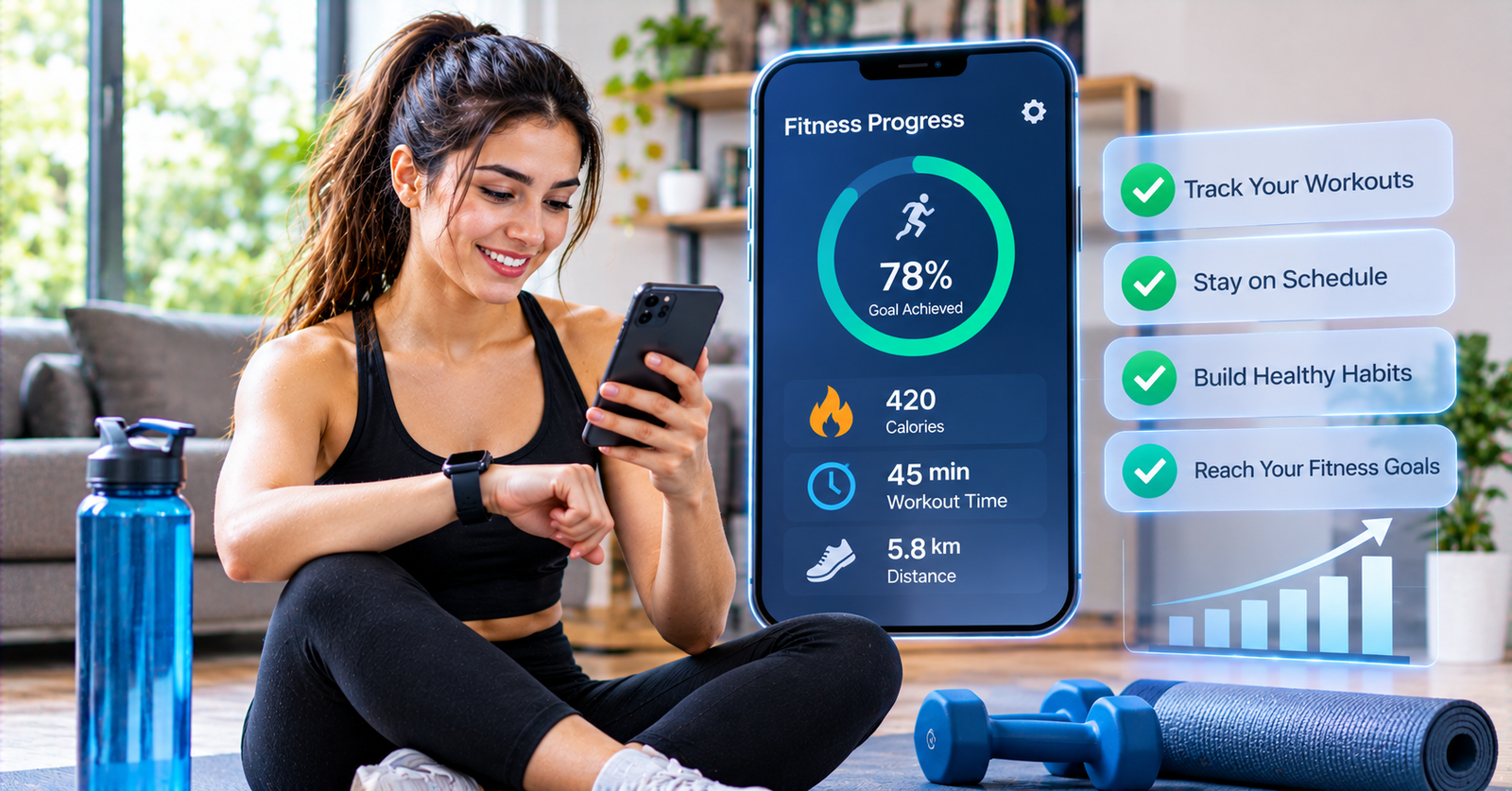
The reward is what reinforces the behavior. Exercise has delayed rewards, the fitness gains and health improvements arrive weeks after the effort, which is why immediate rewards matter so much during habit formation. The app provides immediate rewards in the form that research consistently shows work: completion markers, a visual record of the session, a small progress indicator that shows the week’s sessions completed. Priya checks those after every run. She describes the feeling as disproportionate to the information the screen actually displays, which is the point.
What Data Does That the Mirror Doesn’t
One of the things Priya values most about using an app is that progress became visible in ways that physical appearance alone didn’t provide.
Fitness progress in the first weeks is essentially invisible. The body is adapting at a cellular and cardiovascular level that nothing on the surface reflects yet. The mirror shows nothing different. The scale, if that’s part of the picture, may not move or may move in the wrong direction because muscle is developing. The person is working hard and the evidence of the work is completely hidden.
Apps make the hidden visible. A pace chart that shows the same 5k completing thirty seconds faster after six weeks of training is objective evidence of improvement that the body felt but couldn’t display. A heart rate chart that shows the same pace requiring a lower heart rate over time is evidence that aerobic efficiency is developing. A weekly mileage chart that shows consistent accumulation is evidence of the habit itself, independent of fitness gains.
For the person in the vulnerable early weeks of a new fitness behavior, that visible evidence of progress serves a motivational function that nothing else can. It converts the felt improvement into something that can be pointed to, shared, and returned to when motivation wavers. It says: this is working, the evidence is here, keep going.
The quantified self movement, associated with wearables like Garmin, Polar, Whoop, and Apple Watch, extends this further. Resting heart rate, heart rate variability, sleep quality, and VO2 max estimates turn the body’s adaptation process into a continuous data stream. Users who connect these devices to their fitness apps see not just what they did but what it did to them, which changes the relationship between effort and evidence in ways that sustain engagement through the periods when visible fitness changes are still weeks away.
Accountability That Doesn’t Require Someone Watching
The accountability feature of fitness apps is one of the most research-supported mechanisms in the product category, and it works in a specific way that’s worth understanding.
A person who has told someone they’re going to run on Thursday has a social commitment that acts as a low-level motivation throughout the week. The thought “I said I’d run Thursday” surfaces on Tuesday and Wednesday in a way that keeps the intention alive and makes skipping on Thursday feel like a social consequence rather than a private disappointment.
Apps replicate this in several ways. Strava’s public feed makes completed workouts visible to followers, which creates a mild social visibility that changes how skipping feels. Apps with friend systems show your activity to the people who’ve connected with you. Group challenges create shared goals that have peer accountability built in.
For users who don’t want public workouts, some apps provide accountability through streaks, which create a commitment to the app itself rather than to other people. The streak is a visible record of consecutive days of activity that the user is reluctant to break, partly because breaking it involves a visual erasure of something they built, which creates a psychological cost that functions like social accountability without requiring actual social exposure.
Priya uses both. Her Strava activity is visible to a small group of colleagues who she describes as “aware of my running in a way that makes me slightly more likely to do it.” She also has a streak that she has not broken in thirty-one weeks and which she is quite aware of. She says she’s not motivated by the number specifically. She’s motivated by not wanting to feel what breaking it would feel like.
The Role of Progress Toward a Specific Goal
The difference between exercising generally and training for something specific is one of the most reliable variables in fitness habit formation, and apps that support both are more valuable than apps that support only the general case.
Training for a specific event, a 5k, a half marathon, an open water swim, creates structure that general fitness doesn’t. There’s a date on the calendar. The training plan works backward from that date. Each week has a purpose in the progression. The event serves as an anchor for the entire behavior pattern.
Apps that connect training to events, through race training plans, virtual events, or challenge programs with defined end points, give users who struggle with open-ended goals a time-bounded structure that maintains commitment in ways that “get fitter generally” doesn’t. The person who is training for an October race is more likely to do Thursday’s tempo run than the person who is trying to exercise consistently without a specific end point.
Priya’s first 10k was the external anchor that kept her training through August. She signed up for the event in June, before she felt ready to run a 10k, and the commitment worked backward from October in a way that made the uncomfortable sessions in July necessary rather than optional.
Personalization and the Problem With Generic Plans
A fitness plan written for a generic user will fit some users adequately and frustrate everyone else, and apps have varying degrees of success at addressing this.
The basic personalization most apps provide, tailoring a plan to stated goal, fitness level, available days, and experience level, is better than nothing but is based on what users say about themselves rather than on what their data reveals about them. A user who reports being “intermediate” in fitness is using a category that means different things to different people and may not accurately reflect their actual capacity.
Data-driven personalization, where the app adjusts based on actual performance rather than stated parameters, produces more accurate training loads and better adherence. An app that notices a user consistently completing every set at the top of the prescribed range and adjusts the following sessions upward automatically is responding to real evidence. An app that waits for the user’s quarterly fitness reassessment is reacting to stale data.
The most sophisticated personalization currently available integrates wearable data about recovery alongside training performance to suggest not just what workout to do but whether today is a day to train hard or train easy. Whoop’s daily recovery score and Garmin’s training readiness feature attempt this, with varying accuracy depending on how well the individual’s data has been calibrated.
Building Habit Apps: What the Investment Looks Like
The behavioral research that effective habit apps incorporate isn’t visible in the feature list, but it’s reflected in the development process and cost.
Fitness App Development Cost for a habit-focused mobile product depends significantly on the depth of behavioral personalization, the data integrations, and the social features. A focused app with workout logging, streak mechanics, push notifications, and basic progress tracking for a single platform typically starts around thirty to fifty thousand dollars. Adding wearable integration through Apple HealthKit and Google Health Connect, adaptive plan generation, social features, voice coaching, and native apps for both iOS and Android pushes the budget toward one hundred to one hundred and sixty thousand. Platforms with AI-driven plan adaptation, real-time coaching, live class streaming, and corporate wellness features can exceed two hundred thousand before content production is factored in.
Content production, the actual workouts, coaching scripts, educational material, and training plans, is a parallel cost that habit-focused apps often underestimate. A product that runs users through the same twenty workouts on rotation will see engagement drop as the novelty wears off. A content library that expands over time, with seasonal programs, event training plans, and progressive difficulty, requires ongoing production investment that continues well past launch.
The behavioral mechanics that determine whether users form habits from the app don’t cost much to implement in terms of code, but they cost time to design correctly. The streak logic, the notification timing, the progress visualization, and the reward mechanics each need research-backed design that often comes from iteration with real users rather than from initial specification. Budgeting for a user research phase before the design phase, and for iteration cycles after the first version launches, is part of building a habit app that actually produces habits.
Priya’s October Race
The 10k took her forty-nine minutes. She’d privately hoped for under fifty and was quietly pleased when the chip time came through.
She’s registered for a half marathon in April. The app has already generated the training plan. Week one starts Monday.
She still doesn’t consider herself a runner in the way that people who’ve been running for twenty years consider themselves runners. She considers herself someone who runs, which is a different category that she’s found easier to inhabit. The app made the second category achievable in a way the first wasn’t.
That’s the precise mechanism behind what habit apps do at their best. They don’t create the athlete. They lower the threshold between the person and the behavior often enough, consistently enough, with enough feedback and reward to make the gap between intending to exercise and exercising small enough to cross on a Wednesday evening in November.
That crossing, repeated enough times, becomes something the person does whether the app reminds them or not. The goal was never the app. The goal was the run.
About the Author