Full Service Dental Laboratory: Modern CAD CAM Dental Solutions
Modern dentistry depends on precision, quality materials, and reliable laboratory support to deliver successful patient outcomes. Dental professionals need experienced laboratory partners who can produce accurate restorations while maintaining consistent quality and efficient turnaround times. A full service dental laboratory provides comprehensive solutions for different restorative and prosthetic needs, helping dentists manage everything from routine crowns to complex dental cases. With advancements in digital dentistry, a CAD CAM dental lab also brings greater accuracy, improved production workflows, and customized restoration options to dental practices.
Choosing the right dental laboratory can make a significant difference in the quality of restorative treatments. From digital impressions to final product fabrication, professional laboratories combine technical expertise with modern equipment to support dentists and improve the overall patient experience.
What Is a Full Service Dental Laboratory?
A full service dental laboratory is a specialized facility that manufactures a wide range of dental restorations and prosthetic appliances based on prescriptions and impressions provided by dental professionals. These laboratories work closely with dentists to create customized products that meet individual patient requirements.
Their services commonly include crowns, bridges, veneers, implant restorations, removable dentures, partial dentures, and other restorative appliances. By offering multiple solutions under one roof, a full-service facility helps dental practices simplify laboratory coordination and maintain consistency across different cases.
Experienced dental technicians carefully consider tooth anatomy, bite alignment, material selection, and aesthetic requirements during the fabrication process. Their attention to detail helps ensure that each restoration is designed to fit comfortably and function properly.
Understanding CAD CAM Technology in Modern Dentistry
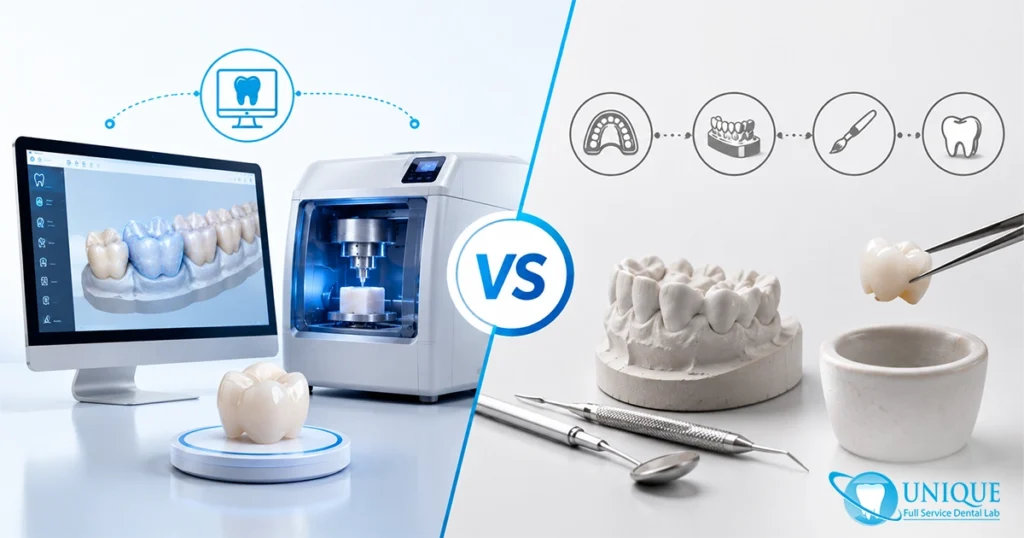
Computer-Aided Design and Computer-Aided Manufacturing, commonly known as CAD CAM, have transformed the way dental restorations are designed and produced. A CAD CAM dental lab uses specialized digital software and manufacturing equipment to create precise dental appliances.
The process generally begins with digital impressions or scanned physical models. These digital records allow technicians to examine the patient’s dental structure and design restorations using advanced computer software. Once the design is finalized, manufacturing equipment produces the restoration from selected dental materials.
Digital workflows can reduce certain manual production steps and support greater consistency. They also allow technicians to make detailed adjustments before manufacturing begins, helping dentists receive restorations that meet specific clinical and aesthetic requirements.
Common Services Offered by a Professional Dental Laboratory
A professional dental laboratory provides different restorative solutions depending on the needs of dental practices and their patients. One important service is crown and bridge fabrication. Crowns restore damaged or weakened teeth, while bridges replace missing teeth by using supporting teeth or implants.
Dental veneers are another popular option. These thin restorations are designed to improve the appearance of teeth by addressing concerns such as discoloration, uneven shapes, and minor imperfections.
Implant restorations are also an essential part of modern laboratory services. Technicians create customized implant-supported crowns and other components designed to work with the prescribed implant system.
Removable dentures and partial dentures help patients replace multiple missing teeth. These appliances require careful attention to fit, comfort, appearance, and functionality.
A laboratory may also provide night guards, retainers, and other custom dental appliances based on the requirements of dental professionals.
Benefits of Choosing a CAD CAM Dental Lab
Digital manufacturing offers several advantages for dental professionals seeking dependable restorative solutions. One major benefit is design precision. Digital software allows technicians to examine restoration dimensions, contours, and contact points before production.
Another advantage is workflow efficiency. Digital scanning and computer-guided manufacturing can simplify communication between dental practices and laboratories. This may help reduce unnecessary adjustments and support more predictable production schedules.
Material options are another important consideration. CAD CAM technology supports the production of restorations using materials such as zirconia, lithium disilicate, and other dental-grade materials, depending on the equipment and clinical requirements.
Digital records can also make it easier to store and retrieve case information when future adjustments or replacements are needed. Combined with skilled technicians, these capabilities help laboratories maintain quality and consistency.
Why Material Selection Matters for Dental Restorations
The materials used in dental restorations directly influence their appearance, strength, and suitability for different clinical situations. Therefore, professional dental laboratories carefully evaluate material options according to the restoration type and dentist’s prescription.
Zirconia is widely used for crowns and bridges because of its strength and versatility. Lithium disilicate is another popular material, particularly for restorations where natural-looking aesthetics are important.
Dental ceramics can provide attractive translucency and color characteristics, making them suitable for selected cosmetic and restorative applications. Acrylic and other specialized materials may be used for removable dentures and temporary appliances.
The ideal material depends on several factors, including the location of the restoration, bite forces, available space, patient expectations, and clinical recommendations. Dental technicians and dentists should work together to select appropriate materials for each case.
How Dental Laboratories Support Dental Practices
Reliable laboratory support helps dental practices manage restorative cases more efficiently. A professional laboratory understands that every restoration must meet the dentist’s specifications while considering the patient’s comfort and treatment objectives.
Clear communication is essential throughout the process. Dentists need to provide accurate impressions, scans, shade information, photographs, and detailed prescriptions when required. Laboratory technicians use this information to develop restorations that align with the planned treatment.
Consistent quality control is equally important. Before completing a case, technicians evaluate factors such as fit, margins, surface finish, shade, and overall design. This attention to detail helps identify potential issues before the restoration reaches the dental practice.
A dependable laboratory relationship can also improve case coordination, reduce communication problems, and support long-term professional collaboration.
Choosing the Right Full Service Dental Laboratory
Selecting a dental laboratory requires more than comparing prices. Dental professionals should evaluate the laboratory’s experience, available services, manufacturing technology, material options, and quality assurance procedures.
It is also important to understand turnaround times and communication practices. A laboratory should provide realistic production schedules and keep dentists informed about case progress.
Reviewing sample restorations and discussing complex cases can help dental professionals assess the laboratory’s technical capabilities. Practices should also consider whether the laboratory offers both conventional and digital workflows to accommodate different clinical requirements.
A strong laboratory partnership is built on reliability, technical knowledge, consistent results, and a shared commitment to patient care.
The Future of Digital Dental Laboratory Services
Digital dentistry continues to evolve through improvements in intraoral scanning, three-dimensional printing, computer-aided design, and automated manufacturing. These technologies are creating new opportunities for dental laboratories to improve production workflows and develop increasingly customized restorations.
As digital systems become more integrated, communication between dental practices and laboratories is expected to become more streamlined. Advanced software may also support more detailed treatment planning and restoration design.
However, technology alone cannot guarantee excellent results. Skilled technicians, appropriate material selection, careful case evaluation, and professional collaboration remain essential parts of successful dental laboratory services.
Frequently Asked Questions
1. What services does a full service dental laboratory provide?
A full service dental laboratory typically provides crowns, bridges, veneers, implant restorations, dentures, partial dentures, night guards, and other customized dental appliances.
2. What is the main advantage of a CAD CAM dental lab?
A CAD CAM dental lab uses digital design and manufacturing technology to support precise restoration production, consistent results, and efficient laboratory workflows.
3. Which materials are commonly used in CAD CAM dental restorations?
Common materials include zirconia, lithium disilicate, dental ceramics, and other specialized dental-grade materials selected according to the restoration and clinical requirements.
Final Thoughts
Choosing a reliable dental laboratory is an important decision for dental professionals who want to provide consistent and high-quality restorative care. A full service dental laboratory offers comprehensive solutions that support different clinical requirements, while a CAD CAM dental lab combines digital technology with skilled craftsmanship to improve restoration design and manufacturing. By focusing on technical expertise, material quality, communication, and modern production methods, dental laboratories can build strong partnerships with dental practices and contribute to better restorative treatment experiences.
About the Author