Sun Exposure and Skin Health – Understanding UV Damage and Effective Sun Protection
Sunlight plays an important role in everyday life, but too much ultraviolet (UV) radiation can damage the skin over time. Understanding Skin Health means knowing how sunlight affects the skin, how to protect it, and when sun exposure becomes harmful.
Although sunlight supports vitamin D production and helps regulate the body’s natural rhythms, excessive exposure can cause sunburn, premature aging, pigmentation changes, and an increased risk of skin cancer.
This guide explains how UV radiation affects the skin, the difference between UVA and UVB rays, practical sun protection methods, and what to do if your skin becomes damaged by the sun.
Skin Health: Understanding the Effects of Sun Exposure
Sunlight contains ultraviolet radiation, which can affect the skin in both beneficial and harmful ways. The amount of exposure, the strength of UV rays, and individual skin characteristics determine how much damage may occur.
The main concern is not simply spending time outdoors. It is receiving excessive UV exposure without adequate protection.
What are UVA and UVB rays?
The sun produces different types of ultraviolet radiation. UVA and UVB are the two main types that reach the Earth’s surface and affect human skin.
UVC rays are largely absorbed by the atmosphere and do not normally reach the Earth’s surface.
| UV radiation | Main effects |
| UVA | Penetrates deeper into the skin and contributes to wrinkles, loss of elasticity, and pigmentation |
| UVB | Mainly affects the outer skin layers and causes sunburn, DNA damage, and vitamin D production |
| UVC | Mostly filtered by the atmosphere under normal outdoor conditions |
UVA rays can pass through some types of glass, which means skin may receive UVA exposure while sitting near a sunny window. UVB rays are generally blocked more effectively by ordinary window glass.
Both UVA and UVB contribute to long-term skin damage and skin cancer risk.
What Are the Short-Term Effects of Sun Exposure?
Excessive sunlight can produce several immediate changes in the skin. Some appear within minutes, while others develop over several hours.
Sunburn and inflammation
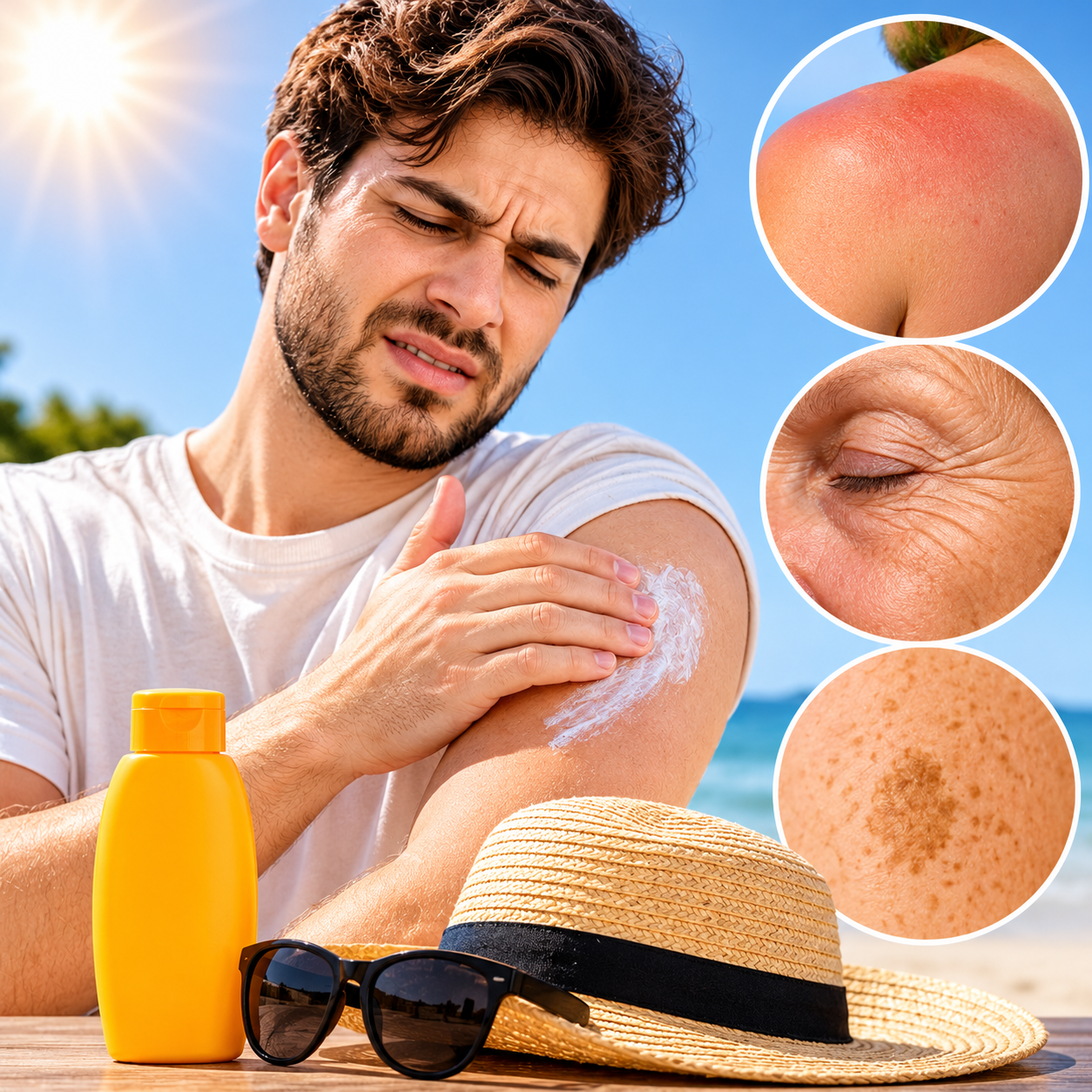
Sunburn is an inflammatory reaction caused by excessive UV exposure. It may develop after spending too much time outdoors without protection.
Common symptoms include:
- Redness or darkening of the affected area
- Warmth and tenderness
- Pain or itching
- Swelling
- Peeling skin after several days
- Blisters in severe cases
Sunburn may not become noticeable immediately. Symptoms often become more apparent several hours after exposure.
People with darker skin may not develop obvious redness, but they can still experience pain, swelling, blistering, and UV-related damage.
Tanning and skin darkening
A tan develops when the skin responds to ultraviolet radiation by producing or redistributing melanin, the pigment responsible for skin color.
Melanin provides some natural protection, but it does not prevent all UV damage. A tan is therefore not a reliable sign of healthy or safe sun exposure.
Repeated tanning can contribute to uneven pigmentation, dark spots, and premature aging. The World Health Organization explains that a UV-induced tan is a response to radiation damage rather than a completely protective process.
Temporary dryness and sensitivity
Sun exposure can leave the skin feeling dry, tight, or irritated. Heat and sweating may also worsen discomfort, especially in people with sensitive skin or existing inflammatory conditions.
After prolonged exposure, the skin barrier may become temporarily weakened. This can increase water loss and make the skin more reactive to soaps, fragrances, and other products.
How Does Sun Exposure Cause Premature Skin Aging?
One of the most noticeable long-term effects of sunlight is photoaging. Photoaging refers to changes in the skin caused by repeated exposure to ultraviolet radiation.
Natural aging occurs gradually, but excessive sunlight can accelerate visible changes.
Wrinkles and loss of elasticity
UVA rays penetrate deeper into the skin and affect structures that help maintain firmness and elasticity.
Repeated exposure can contribute to the breakdown of collagen and elastin, proteins that support the skin.
Over time, this may lead to:
- Fine lines around the eyes and mouth
- Deeper wrinkles
- Loose or sagging skin
- Rough texture
- Reduced firmness
The face, neck, hands, and forearms often show these changes because they receive frequent sunlight.
Age spots and uneven pigmentation
Long-term sun exposure can stimulate pigment-producing cells and contribute to dark spots, commonly called sun spots or age spots.
These flat brown patches often appear on areas that receive frequent sunlight, such as the cheeks, forehead, shoulders, and backs of the hands.
People with darker skin tones may also experience worsening hyperpigmentation after sun exposure, particularly when inflammation or acne is present.
Protecting Skin Health from early adulthood can help reduce the visible effects of photoaging later in life.
Can Sun Exposure Increase the Risk of Skin Cancer?
Yes. Excessive ultraviolet radiation can damage the DNA inside skin cells. If damaged cells are not properly repaired, abnormal growth may develop and potentially lead to skin cancer.
The main types of skin cancer associated with UV exposure include:
Basal cell carcinoma
Basal cell carcinoma is the most common type of skin cancer. It often develops on sun-exposed areas and may appear as a shiny bump, a pink patch, or a sore that does not heal.
It usually grows slowly, but it can damage surrounding tissue if left untreated.
Squamous cell carcinoma
Squamous cell carcinoma may appear as a rough, scaly patch, a firm bump, or a persistent sore.
Long-term cumulative UV exposure is an important risk factor. This cancer can sometimes spread to other parts of the body, particularly when treatment is delayed.
Melanoma
Melanoma is less common than some other skin cancers but can be more dangerous because it may spread rapidly.
Warning signs include a mole that changes in size, shape, or color, or a new unusual mark on the skin.
The ABCDE rule can help identify suspicious moles:
- A – Asymmetry: One half looks different from the other.
- B – Border: The edges are irregular or poorly defined.
- C – Color: The mole has several colors or uneven pigmentation.
- D – Diameter: The spot is larger than a pencil eraser, although melanoma can be smaller.
- E – Evolving: The spot changes over time.
Any new, changing, bleeding, or non-healing skin lesion should be examined by a healthcare professional.
The World Health Organization identifies UV radiation as a major cause of skin cancer and recommends protective measures whenever the UV Index reaches 3 or above.
World Health Organization+1
Does Sun Exposure Affect Existing Skin Conditions?
Sunlight may worsen certain skin conditions, while others may improve temporarily with carefully supervised medical phototherapy. The effect depends on the diagnosis, the type of UV radiation, and the person’s individual response.
Sun sensitivity and photosensitive reactions
Some people develop a rash after exposure to sunlight. This may be due to a condition called polymorphic light eruption, a medication reaction, or another photosensitivity disorder.
Symptoms can include:
- Itchy red or raised patches
- Small bumps or blisters
- Burning or stinging sensations
- Rashes on the chest, arms, or hands
Certain medications, including some antibiotics and other prescription drugs, can make the skin more sensitive to sunlight. Some fragrances, cosmetics, and plant compounds may also trigger reactions.
If a rash repeatedly appears after sun exposure, seek medical advice rather than assuming it is ordinary sunburn.
Sun exposure and granuloma annulare
Granuloma annulare is a skin condition that commonly causes ring-shaped bumps or patches. It is generally considered a benign inflammatory condition, and its exact cause is not fully understood.
Sunlight does not have a proven universal effect on this condition. Some people may notice irritation or changes in affected areas after exposure, while others do not experience any clear connection.
People researching Herbal Supplements for Granuloma Annulare should understand that supplements have not been established as a cure. Evidence for herbal approaches is limited, and supplements may interact with medicines or cause unwanted effects. Discuss any complementary approach with a qualified healthcare professional.
Can sunlight help certain skin conditions?
Controlled UV treatment, known as phototherapy, is sometimes used for conditions such as psoriasis and eczema. This treatment is delivered under medical supervision, with carefully selected wavelengths and exposure levels.
Medical phototherapy is different from deliberately tanning or spending long periods in direct sunlight. Unsupervised UV exposure can cause burns, worsen pigmentation, and increase long-term cancer risk.
Never attempt to treat a skin condition with intense sunlight without advice from a dermatologist.
How Can You Protect Your Skin from the Sun?
The most effective approach combines several protective habits rather than relying on sunscreen alone.
1. Check the UV Index
The UV Index measures the strength of ultraviolet radiation. A higher number means a greater potential for damage and a shorter time before harm can occur.
Use these general guidelines:
- UV Index 0–2: Low risk, although protection may still be useful during prolonged exposure.
- UV Index 3–5: Moderate risk; use sun protection.
- UV Index 6–7: High risk; limit direct exposure and protect exposed skin.
- UV Index 8–10: Very high risk; take extra precautions.
- UV Index 11 or above: Extreme risk; avoid direct exposure as much as possible.
Sun protection is recommended when the UV Index is 3 or higher. Check a local weather service or reliable UV forecast before outdoor activities.
2. Seek shade during peak sunlight
UV radiation is often strongest around midday, although the exact timing depends on location, season, and weather.
When possible:
- Plan outdoor activities for early morning or later afternoon.
- Stay under trees, umbrellas, or covered areas.
- Avoid prolonged direct sunlight during high UV periods.
- Remember that shade does not block every reflected or scattered UV ray.
Sand, water, concrete, and other surfaces can reflect sunlight and increase exposure.
3. Wear protective clothing
Clothing is one of the simplest ways to reduce direct UV exposure.
Choose:
- Lightweight, long-sleeved shirts
- Trousers or long skirts
- Tightly woven fabrics
- A wide-brimmed hat that covers the face, ears, and neck
- Sunglasses with reliable UVA and UVB protection
Clothing with an ultraviolet protection factor (UPF) label provides a measurable level of protection. Darker or more tightly woven fabrics may block more UV than thin, loosely woven materials, although comfort and coverage are also important.
4. Use broad-spectrum sunscreen
A broad-spectrum sunscreen protects against both UVA and UVB radiation. The American Academy of Dermatology recommends sunscreen with SPF 30 or higher, broad-spectrum protection, and water resistance.
For everyday use:
- Apply sunscreen to all exposed skin.
- Use it before going outdoors, following the label instructions.
- Reapply approximately every two hours.
- Reapply after swimming, sweating, or towel drying.
- Do not rely on sunscreen to stay in direct sunlight for longer.
SPF mainly measures protection against sunburn-causing UVB radiation. Broad-spectrum labeling is important because it also indicates UVA protection.
What Is the Best Sunscreen for Everyday Skin Protection?
The best sunscreen is one that suits your skin type and that you will apply consistently.
Sunscreen for dry skin
Cream-based sunscreens may feel more comfortable for dry skin. Look for moisturizing ingredients such as glycerin or ceramides if they suit your skin.
Sunscreen for oily or acne-prone skin
Lightweight lotions, gels, or fluid formulations may feel less greasy. Look for products labeled non-comedogenic if you are prone to clogged pores.
Sunscreen for sensitive skin
Fragrance-free formulations may be helpful for people who experience irritation. Mineral sunscreens containing zinc oxide or titanium dioxide are often considered options for sensitive skin, but individual reactions can vary.
Sunscreen for pigmentation concerns
Visible light may contribute to darkening of certain pigmentation disorders. A tinted sunscreen containing iron oxides may offer additional protection against visible light, alongside broad-spectrum UV protection.
American Academy of Dermatology
Remember that sunscreen is only one part of a complete sun protection routine. Hats, clothing, shade, and sensible outdoor habits remain important.
Can Sunlight Provide Vitamin D Without Damaging the Skin?
Sunlight helps the body produce vitamin D, which supports calcium absorption, bone strength, and normal muscle function.
However, there is no single amount of sun exposure that is safe and sufficient for everyone. Vitamin D production depends on factors such as skin pigmentation, age, location, season, clothing, and time outdoors.
A person with darker skin may need more UV exposure to produce the same amount of vitamin D as someone with lighter skin, but this does not mean prolonged unprotected exposure is advisable.
For better Skin Health, avoid using sunburn or tanning as a method of obtaining vitamin D. Vitamin D can also come from foods such as oily fish, fortified foods, and medically recommended supplements.
If you are concerned about vitamin D deficiency, speak with a healthcare professional about whether testing or supplementation is appropriate. The World Health Organization advises that vitamin D needs should not be met through artificial tanning devices.
World Health Organization+1
What Should You Do After Sunburn?
If your skin becomes sunburned, stop further exposure and begin gentle care as soon as possible.
Immediate steps for sunburn relief
- Move into shade or indoors.
- Cool the affected area with a cool shower, bath, or damp towel.
- Apply a gentle, fragrance-free moisturizer.
- Drink water to help maintain hydration.
- Avoid further sunlight until the skin has healed.
- Do not scratch, peel, or pop blisters.
Avoid placing ice directly on sunburned skin. Do not use harsh exfoliants, alcohol-based products, or irritating skincare ingredients while the skin is inflamed.
For mild sunburn, discomfort usually improves over several days. Peeling may occur as the damaged outer skin sheds.
When should you seek medical attention?
Get medical advice if you experience:
- Extensive or severe blistering
- Significant swelling
- Fever or chills
- Severe pain
- Dizziness, nausea, or confusion
- Signs of dehydration
- Sunburn affecting a young child
Severe sunburn may be associated with heat exhaustion or heatstroke, which require prompt medical attention.
Can Natural Skincare Help Maintain Skin Health?
A gentle skincare routine can support the skin barrier, especially after outdoor exposure. However, skincare products cannot reverse all UV-related damage or replace sun protection.
Daily habits that support the skin barrier
Consider these simple habits:
- Cleanse gently without scrubbing.
- Apply moisturizer after bathing.
- Avoid very hot showers if your skin feels dry.
- Use fragrance-free products if you are sensitive.
- Wear sunscreen during outdoor activities.
- Keep hydrated and eat a balanced diet.
People exploring Herbal Care Products should choose products carefully and check the ingredient list for possible irritants. Natural ingredients are not automatically safe for every skin type, and some botanical ingredients can trigger allergic or photosensitive reactions.
Avoid applying concentrated essential oils, citrus juices, or untested herbal mixtures to sunburned skin. These may irritate the skin or increase sensitivity to sunlight.
A simple, consistent routine is usually more helpful than using many products at once.
What About Natural Approaches for Granuloma Annulare?
Granuloma annulare may improve on its own in some people, although it can persist or recur. Treatment depends on the type, severity, location, and symptoms.
A dermatologist may recommend observation, topical corticosteroids, injections, or other treatments when necessary. Some cases require additional medical evaluation.
People searching for Granuloma Annulare Natural Treatment should be cautious about claims that sunlight, herbs, or supplements can reliably eliminate the condition. There is not enough strong clinical evidence to establish natural remedies as a cure.
Gentle skincare and avoiding unnecessary irritation may help comfort, but they do not replace diagnosis or evidence-based treatment. If the patches spread, become painful, or the diagnosis is uncertain, consult a dermatologist.
Everyday Habits for Long-Term Skin Health
Protecting the skin does not require avoiding outdoor activities completely. The goal is to enjoy sunlight while reducing excessive UV exposure.
A practical daily routine includes:
- Check the UV Index before spending extended time outdoors.
- Use shade during periods of strong sunlight.
- Wear protective clothing and sunglasses.
- Apply broad-spectrum SPF 30 or higher sunscreen to exposed areas.
- Reapply sunscreen as directed.
- Avoid tanning beds and intentional tanning.
- Examine your skin regularly for new or changing spots.
- Seek professional advice for persistent skin changes.
These habits can reduce the risk of sunburn, photoaging, and UV-related skin cancer while helping maintain the skin’s natural barrier.
How Can You Build a Sun-Safe Skincare Routine?
A routine works best when it is easy to follow every day. You do not need a complicated collection of skincare products to protect yourself from UV radiation.
Morning routine
- Wash your face with a gentle cleanser.
- Apply a moisturizer suitable for your skin type.
- Use broad-spectrum SPF 30 or higher sunscreen.
- Apply sunscreen to your ears, neck, hands, and other exposed areas.
- Wear protective clothing when spending time outdoors.
Evening routine
- Gently remove sunscreen, sweat, and dirt.
- Apply a moisturizer to support the skin barrier.
- Check for unusual changes, persistent irritation, or new spots.
Consistent sun protection is one of the most useful habits for maintaining Skin Health. It can help reduce the visible effects of aging and lower the risk of UV-related skin damage.
How can you protect your skin during outdoor activities?
When walking, gardening, exercising, or traveling, plan ahead. Carry sunscreen, wear a hat, and take breaks in shaded areas.
If you spend several hours outdoors, remember that sunscreen gradually wears off. Reapplication is especially important after sweating or swimming.
For people who work outdoors, protective clothing and scheduled shade breaks can make a meaningful difference. Employers should also provide appropriate sun protection measures when workers have regular occupational UV exposure.
Good Skin Health habits should be practical, consistent, and suitable for your daily lifestyle.
Frequently Asked Questions
Does sunlight improve skin health?
Sunlight supports vitamin D production, but excessive UV exposure can cause sunburn, premature aging, pigmentation, and skin cancer. A balanced approach includes sensible outdoor activity and sun protection.
Can sunlight damage skin even on cloudy days?
Yes. Clouds do not block all UV radiation. UV exposure can still occur on overcast days, so use protection when the UV Index is 3 or higher.
Is a tan a sign of healthy skin?
No. A tan is a response to UV exposure and indicates that the skin has activated protective pigment processes. It does not mean the skin is free from damage.
Does sunscreen prevent all skin damage?
No sunscreen blocks every UV ray. Sunscreen reduces exposure when used correctly, but shade, protective clothing, and avoiding excessive sunlight are also important.
Can darker skin tones get sunburn?
Yes. Melanin offers some natural protection, but people with darker skin can still experience sunburn, pigmentation changes, premature aging, and skin cancer.
How often should sunscreen be reapplied?
Most sunscreen guidance recommends reapplying approximately every two hours while outdoors, and after swimming, sweating, or towel drying. Follow the specific product label.
What are the first signs of sun damage?
Early signs may include sunburn, uneven pigmentation, freckles or dark spots, rough texture, and fine lines. Persistent or changing lesions should be examined by a healthcare professional.
Does sunlight cause granuloma annulare?
There is no established evidence that sunlight is a universal cause of granuloma annulare. The condition has an uncertain cause, and individual experiences with sun exposure may differ.
Conclusion
Sunlight can support vitamin D production, but excessive UV radiation may harm the skin in several ways. It can cause sunburn, pigmentation changes, premature aging, and an increased risk of skin cancer.
Protecting Skin Health means enjoying outdoor activities while taking sensible precautions. Use sunscreen, wear protective clothing, seek shade, and avoid intentional tanning.
The most effective approach is prevention. Consistent sun protection can help preserve the skin’s appearance, reduce UV-related damage, and support long-term Skin Health.
Medical Disclaimer
This article is for educational and informational purposes only and is not a substitute for professional medical advice, diagnosis, or treatment. Skin conditions can have different causes and may require individual evaluation. Consult a qualified dermatologist or healthcare professional if you have persistent skin symptoms, unusual moles, severe sunburn, or concerns about a skin condition. Do not start herbal supplements or discontinue prescribed treatment without discussing it with your healthcare provider.
About the Author